AI: Solving the power bottleneck

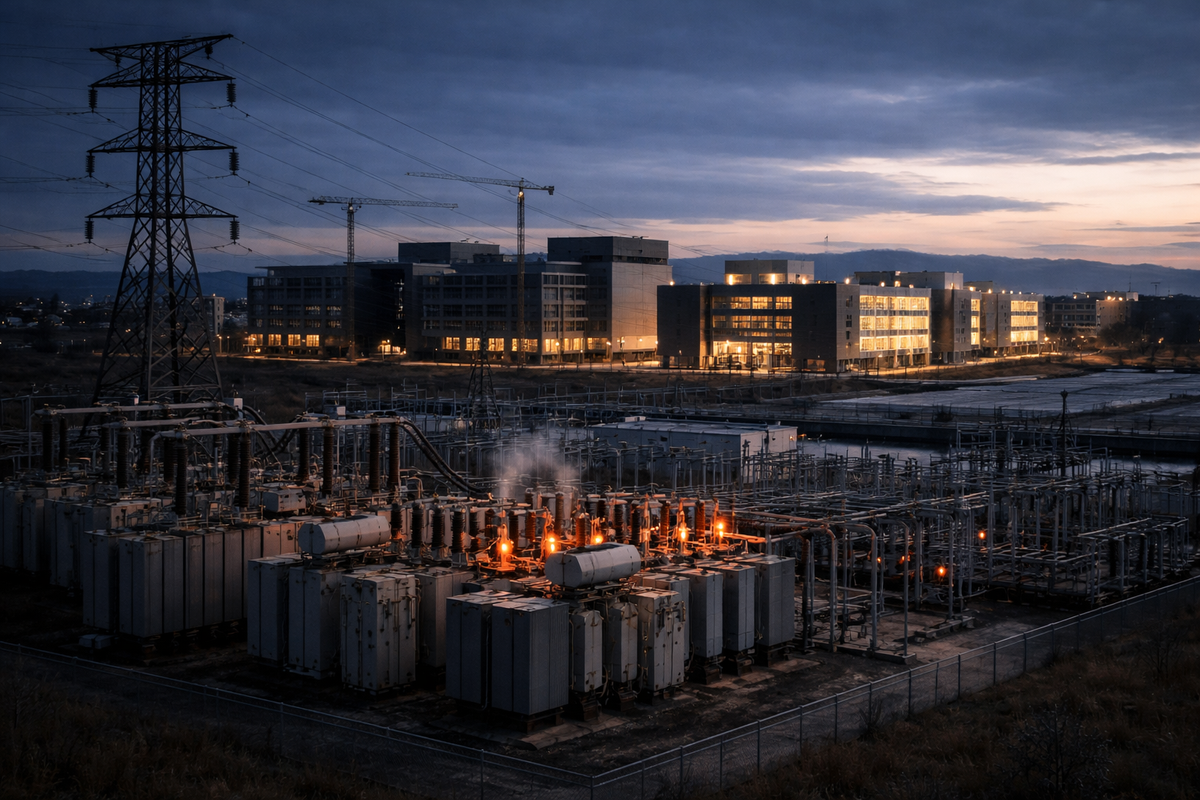
The AI race is still often described as a race for chips, but that framing is rapidly becoming outdated. The tighter constraint is increasingly electricity: generation, transmission, substations, transformers, cooling, and the long construction timeline needed to turn ordered hardware into working capacity. The International Energy Agency (IEA) estimates data centres used about 415 TWh of electricity in 2024 and could reach roughly 945 TWh by 2030, with AI as the main driver of that increase. In the United States, the Department of Energy says utilities are now seeing connection requests for hyperscale facilities in the 300 MW to 1,000 MW range, while DOE’s transformer resilience report says large power transformer lead times are commonly around 36 months and can stretch to 60 months. Lawrence Berkeley National Laboratory adds that the typical project that eventually gets built now spends more than four years moving from interconnection request to commercial operation.
Seen globally, AI is not the whole electricity story; the IEA says data centres account for around one-tenth of global electricity-demand growth to 2030. But AI load is unusually concentrated, which is why local bottlenecks matter much more than global averages. A region can run short of transformer capacity, cooling infrastructure, transmission access or substation space long before the world runs short of electrons in aggregate. That is why the central question for next-generation AI infrastructure is shifting from “How many GPUs can we buy?” to “How many powered, cooled megawatts can we bring online?”
Better chips will help, but they will not remove the power problem
Chip roadmaps themselves are mostly pointing toward less energy per unit of useful compute, not more. AMD says it exceeded its prior AI/HPC efficiency goal and now aims for a 20x gain in rack-scale AI energy efficiency by 2030. TSMC says its N2P process can deliver either an 18% performance increase at the same power or a 36% power reduction at the same speed compared with N3E. The direction of travel is clear: better performance per watt.
But the systems built around those chips are becoming dramatically denser. NVIDIA rates a DGX B200 at about 14.3 kW, rack-scale Blackwell systems sold by partners are already above 100 kW, and NVIDIA’s 800 VDC roadmap is explicitly designed for racks ranging from 100 kW to more than 1 MW. So the likely future is lower energy per token, query or training step, but higher power per rack and, in aggregate, more electricity consumption because deployment keeps expanding faster than efficiency alone can offset.
Quantum computing is not a near-term escape hatch
Quantum computing matters, but it is not a near-term answer to AI’s scaling bottleneck. IBM’s current strategy is explicitly “quantum-centric supercomputing”: quantum processors working alongside CPUs, GPUs, shared storage and high-speed networks in a coordinated environment. IBM’s own roadmap targets the first large-scale, fault-tolerant quantum computer for 2029, and its System Two architecture combines quantum hardware with cryogenic infrastructure and classical runtime servers. In other words, quantum adds a new layer to the compute stack; it does not remove the need for conventional supercomputing this decade.
Renewables are essential, but they are not the whole answer
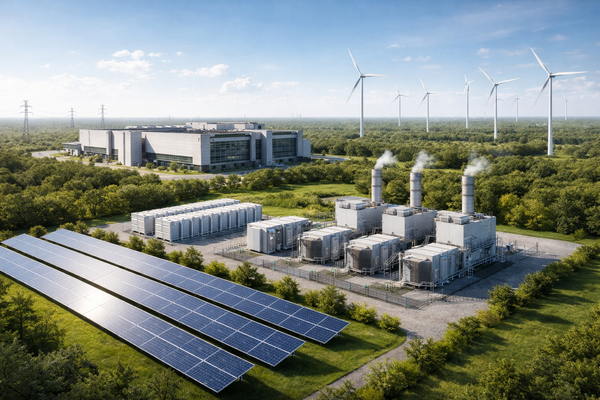
Renewables will be indispensable to AI’s future. The IEA expects them to meet about half of global growth in data-centre electricity demand, but it also says dispatchable sources led by natural gas remain crucial and that gas expands materially to meet the rise in load. That makes the most realistic near-term answer a hybrid one: more wind, solar and hydro where they are cheapest and fastest, more storage where it adds flexibility, and firm generation where 24/7 reliability is non-negotiable.
Batteries and BESS are part of that stack, but mainly as a flexibility tool rather than a full substitute for always-on generation. The IEA says battery storage is especially valuable for short-duration balancing in roughly the 1-to-8-hour range. The chemistry mix is also shifting in a helpful direction: lithium iron phosphate now dominates much of stationary storage and, unlike other common lithium-ion chemistries, does not use nickel or cobalt. But the manufacturing chain remains highly concentrated. The IEA says China still holds nearly 85% of global battery cell production capacity, even as global battery manufacturing capacity reached 3 TWh in 2024 and could expand much further. So the challenge is not only raw mineral availability, it is also refining, cell production and geopolitical concentration upstream.
SMRs are promising, but mostly a 2030s story
Small modular reactors deserve serious attention, but not magical thinking. The International Atomic Energy Agency says there are more than 80 SMR designs and concepts globally, yet only four are currently in advanced stages of construction. The first flagship projects now moving ahead, including Ontario Power Generation’s Darlington SMR and TerraPower’s Natrium plant, are targeting around 2030 for grid connection or completion. That makes SMRs plausible as part of the medium-term power mix for very large AI campuses, especially where operators want firm low-carbon electricity, but not the main fix for the next few years of transformer shortages, interconnection queues and data-centre buildout delays.
Cutting building demand helps, but it is not fast enough on its own
One of the most sensible ways to make room for AI is to reduce demand elsewhere, especially in homes and buildings. Buildings account for about 30% of global final energy consumption and more than half of electricity use, and the IEA says replacing fossil-fuel boilers with high-efficiency heat pumps can reduce energy use by up to 75%. That is a huge opportunity.
The problem is pace. Energy-efficiency renovation rates are still less than 1% in most major markets, while getting on track for net zero would require something closer to 2.5% a year by 2030. So making housing and commercial buildings more efficient absolutely helps ease system pressure, but it is a medium-term pressure reliever, not a substitute for building new supply, transmission and grid infrastructure for AI in the near term.
What the future most likely looks like
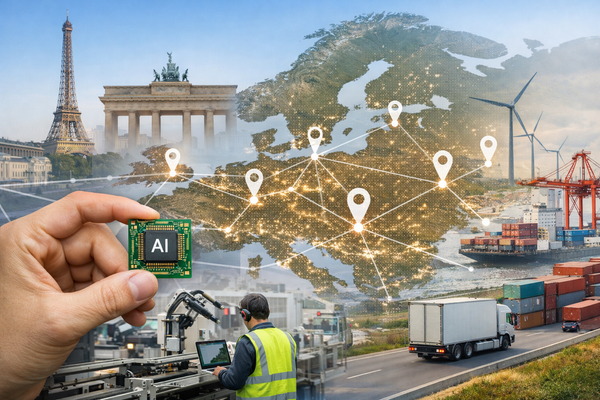
The most likely future is not that AI stops scaling. It is that AI becomes much more power-aware and much more geographically selective. The IEA explicitly points to locating new data centres in areas with stronger power and grid availability as one of the clearest ways to reduce delay risk, and it warns that grid queues and component shortages are already material constraints. That suggests the next big AI campuses will increasingly cluster where electricity can be secured, not just where talent or tax incentives are strongest.
That has a major implication for supply chains. The real AI race is broadening beyond GPUs into transformers, switchgear, copper, cooling equipment, battery cells, turbines, skilled electrical labour and permitting. Massive-scale AI will happen, but it will be shaped less by software ambition alone and more by the physical economy around it. In the next phase of the AI boom, the winners will not just be the firms with the smartest models, they will be the ones that can secure, build and operate energy infrastructure at industrial scale.