Large-scale BESS & VPP: Turning renewable oversupply into AI-ready power for data centres

AI is pushing data centres into a new class of electricity consumer: high-density, highly continuous, and increasingly time-sensitive. At the same time, renewables are scaling rapidly, but grids were not designed for variable generation at today’s volumes. The result is a paradox we see more and more often:
- Clean energy is available, but not always usable when it’s generated
- Clean energy generation exceeds demand and therefore needs curtailing to prevent damage to the grid
- Power-hungry industries need firm, predictable power right when they need it.
This is exactly where large-scale Battery Energy Storage Systems (BESS) and Virtual Power Plants (VPPs) come in. Together, they form the flexibility layer that converts intermittent renewables into dependable, dispatchable energy, the kind of energy AI-era infrastructure requires.
The real problem isn’t renewable generation, it’s flexibility.
Wind and solar output is weather-driven, demand is not. When renewable output exceeds what the grid can absorb locally (or transmit to where it’s needed), the system has to take corrective actions: curtail generation in one place, and dispatch something else in another.
In the UK, these constraint and balancing actions have become expensive and increasingly visible, with reports highlighting hundreds of millions in constraint-related payments and broader system costs driven by congestion and curtailment.
So the opportunity is clear:
If we can store surplus renewable electricity and release it at the right time and location, we can reduce curtailment, stabilise prices, and supply firm power to large loads.
What large-scale BESS actually does (and why “large-scale” matters)
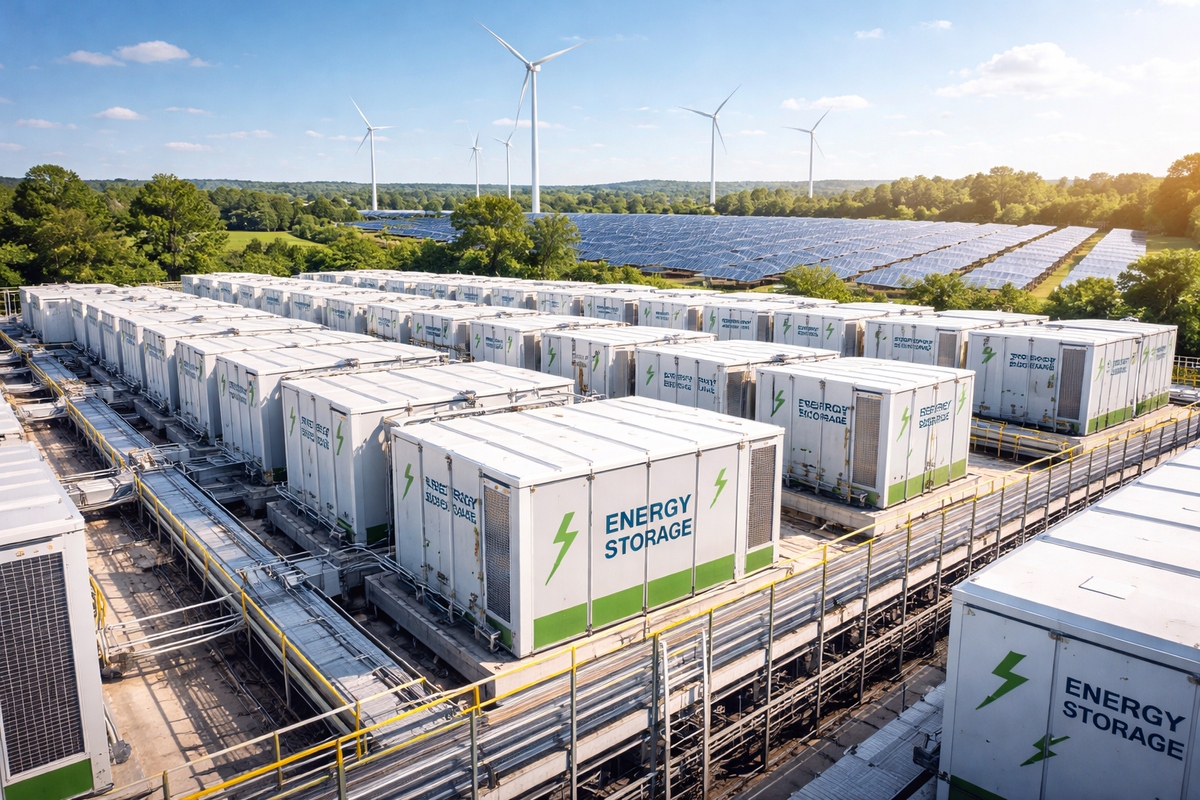
A battery energy storage system (BESS) is not just a battery container. Utility- and industrial-scale BESS is a full grid asset: batteries + inverters + protection + cooling + controls (EMS) engineered to deliver multiple services safely and repeatedly.
Core benefits of large-scale BESS
- Time-shifting renewables (capture → hold → dispatch)
- Charge when wind/solar output is high (and prices may be low).
- Discharge during peaks, constraint windows, or when renewable output drops.
- Firming and smoothing (turning variable into “usable”)
- Batteries can dampen volatility and provide a more predictable power profile to the grid and to large customers.
- Fast grid support
- Batteries respond extremely quickly, which is valuable as grids deal with more rapid changes in supply/demand.
- Congestion and constraint relief
- Storage placed in the right electrical location can absorb energy that would otherwise be curtailed and reduce stress on constrained corridors.
Why “large-scale” changes the game
Large-scale BESS (tens to hundreds of MW) is what allows:
- meaningful curtailment capture,
- impactful grid services provision,
- and commercially viable “stacking” of multiple value streams (arbitrage + services + network value).
In short, large-scale BESS is what moves storage from “helpful on-site backup” to “system-level infrastructure”.
What a VPP is, and why it’s the multiplier
A Virtual Power Plant (VPP) is an orchestration layer: software that aggregates and controls many distributed energy resources (DERs) such as batteries, flexible loads, and generation, so they behave like a single dispatchable power plant.
VPPs matter because the future grid is increasingly decentralised:
- batteries at sites,
- solar on roofs and land,
- flexible industrial loads,
- EV charging,
- and many smaller assets that, individually, are “too small to matter” — but together are massive.
A VPP:
- forecasts,
- optimises,
- dispatches,
- and (where market rules allow) bids aggregated flexibility into energy and ancillary service markets.
Regulators have been moving to enable this participation. For example, in the US, FERC Order 2222 is aimed at enabling aggregated DERs to participate in organised wholesale markets.
BESS is the physical flexibility. VPP is the coordination and monetisation engine.
Why this matters specifically for data centres and AI
The International Energy Agency projects global electricity consumption for data centres could more than double to ~945 TWh by 2030, driven heavily by AI and other digital services.
This creates three practical challenges for data-centre growth:
1) Power availability and timelines
Grid connection queues and reinforcement timelines are becoming a primary constraint for new campuses and expansions. Even where energy exists in the wider system, local network capacity and constraints dictate what can be delivered to a specific site.
2) Power quality and operational resilience
High-density compute and AI workloads increase sensitivity to disturbances, ramp events, and the cost of outages. Power quality and controllability become more valuable as load becomes larger and more continuous.
3) Decarbonisation expectations are rising
Large customers and regulators increasingly want better evidence of “clean power” beyond annual matching. That pushes the market toward more granular matching and firming — which storage and orchestration directly enable.
How BESS + VPP “captures” renewables and turns it into firm supply for large loads
Here’s the practical mechanism, end-to-end:
Step A: Identify the “waste” and the “stress”
- Waste: renewable curtailment windows, negative/low-price periods, local export constraints.
- Stress: evening peaks, ramp periods, constrained transmission boundaries, contingency risks.
Step B: Deploy storage where it has electrical leverage
- Front-of-meter (grid-scale): installed as a grid asset to charge/discharge against network constraints and market needs.
- Behind-the-meter (on-site): installed at an industrial facility (e.g., a data centre) to shape grid import/export and support resilience.
Step C: Orchestrate with VPP logic
A VPP (or equivalent EMS/portfolio optimiser) coordinates charging and discharging across:
- pricing signals,
- grid constraints,
- renewable availability,
- asset degradation limits,
- and reliability requirements.
Result: more renewables used, fewer constraints, more firm energy delivered
- Renewables that would be curtailed can be stored.
- Peak stress can be reduced.
- Large loads can be served with a more stable and controllable profile.
The commercial logic: “revenue stacking” and total system value
BESS economics are rarely based on a single use-case. The best projects are designed for stacked value, such as:
- energy arbitrage (time-shift),
- ancillary services,
- capacity/peak value,
- constraint management/network value,
- and (for behind-the-meter) avoided demand charges and resilience value.
VPP capability improves this by:
- optimising across a portfolio,
- improving dispatch accuracy,
- and enabling aggregated participation where market rules support it.
For data centres, an equally important point is operational rather than purely commercial:
Storage can turn an otherwise volatile grid interface into a managed operating envelope.
That can be worth a lot when your revenue depends on uptime and predictable expansion.
What this means in practice for data-centre developers and operators
A pragmatic architecture decision tree often looks like this:
Option 1: Grid-scale BESS near renewable generation or constrained nodes
Best when you want to:
- reduce curtailment,
- relieve network constraints,
- and enable firm delivery into high-value windows at scale.
Option 2: Behind-the-meter BESS at the data-centre campus
Best when you want to:
- smooth ramps and peaks,
- reduce import capacity stress,
- add resilience/ride-through options,
- and potentially export flexibility (if rules/contracts allow).
Option 3: Hybrid (grid-scale + campus-scale) coordinated as a “portfolio”
Best when you want to:
- firm renewables upstream,
- manage the campus load downstream,
- and optimise both via orchestration.
The “right answer” depends on grid topology, connection terms, market access, and your operational reliability philosophy.
Where blocz fits: compute infrastructure and energy infrastructure, engineered together
Most organisations looking at BESS or VPP solutions hit the same friction points:
- unclear business case (what value streams are real here?),
- grid connection complexity (what’s feasible at this node and timeframe?),
- engineering risk (protection, commissioning, safety, warranty),
- and controls risk (how do we optimise without compromising reliability?).
blocz is positioned to help because we operate at the intersection of:
- high-density data-centre delivery, and
- battery and electrical infrastructure execution, alongside a partner ecosystem with proven large-scale deployment capability (including major BESS installations).
That combination matters because, for AI-era sites, power is no longer a utility checkbox, it’s a core part of the product.
A credible “AI-ready power plan” is increasingly as important as the building itself.
In practical terms, blocz can support:
- feasibility and grid strategy (front-of-meter vs behind-the-meter vs hybrid),
- design basis and operating philosophy (reliability-first controls, reserve SOC rules),
- integration into high-density data-centre electrical architecture,
- delivery coordination and commissioning discipline,
- and an optimisation roadmap (VPP-ready telemetry, dispatch rules, cybersecurity).
In Summary
The AI boom is accelerating data-centre power demand, and renewables are scaling, but the grid needs flexibility to connect the two. Large-scale BESS captures surplus renewable energy and releases it when needed. VPPs coordinate fleets of assets so the system behaves like a controllable power plant.
Together, they provide one of the fastest, most scalable pathways to:
- reduce renewable curtailment,
- stabilise grids under high renewable penetration,
- and supply firm, dependable power to the world’s most electricity-intensive digital infrastructure.