The big question on everyone's lips: Will the AI bubble burst?

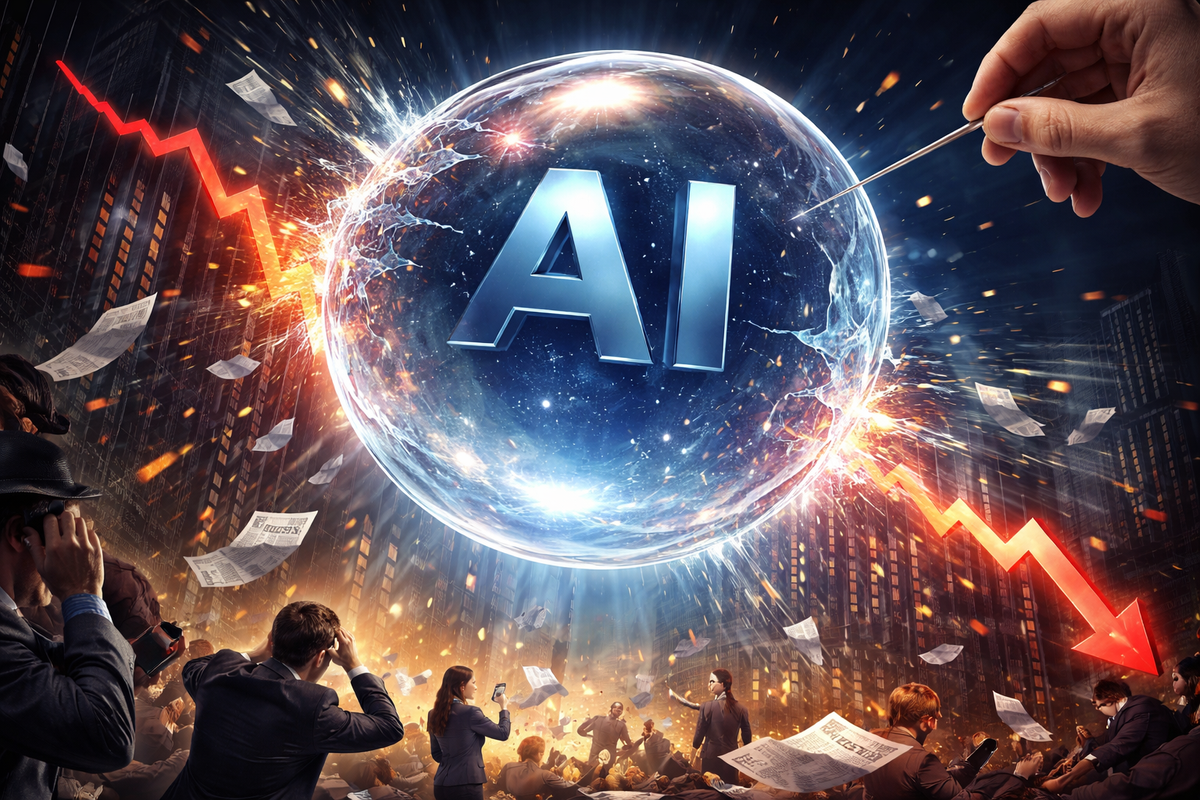
Every few months, the same question returns: is AI a bubble? I think that fundamentally wrong; markets can overshoot, weak companies can fail, hype can run ahead of reality. But none of that really determines whether the underlying technology is foundational. The question I care about is whether AI is becoming one of the base layers of the modern economy. I believe it is!
Why I believe the bubble question misses the point
When I hear the bubble question, I separate speculation around AI companies from the significance of AI itself as they are clearly not the same thing. Capital can absolutely chase bad ideas, and valuations can get ahead of real-world value. But underneath that noise, I see something much larger taking shape: AI being built into enterprise software, cloud infrastructure, research, operations, and the day-to-day workflows of companies at scale. That is not what a passing fad looks like to me.
That is also why BlackRock Chairman and CEO Larry Fink’s framing resonates with me. In his 2026 chairman’s letter, he said AI is “here to stay,” called it the most significant technology “since, at least, the computer,” and argued that leadership in AI requires sustained investment in research, infrastructure, talent, and capital markets. I do not read that as the language of a craze nearing exhaustion, I read it as the language of a long-duration fundamental shift.
Why I believe AI is more like the internet than the dot-com crash
The analogy I keep coming back to is not the dot-com crash, it is the internet itself. The dot-com bust wiped out companies with weak economics and unrealistic business models, but it did not invalidate the internet. The network kept spreading, the application layer kept deepening, and the internet eventually became embedded in commerce, communication, media, and everyday life. By 2025, the ITU estimated that 74% of the world’s population was online. That is why I think the right lesson from the dot-com era is not that transformational technologies vanish when the hype breaks, it is that speculation can crack while the foundation keeps compounding.
I believe AI sits in that same category. To me, AI is not just another software feature or product cycle, it is an enabling layer that other products, services, and industries will build on top of. The companies at the edge may change, and some business models may fail, but the capability itself looks durable in the same way the internet did when it moved from novelty to critical infrastructure.
Why I believe the adoption curve is the strongest evidence
If I want to know whether AI is real or merely fashionable, I look first at adoption. On that measure, I think the evidence is unusually strong. NBER researchers found that generative AI reached a 39.5% adoption rate after two years, compared with 20% for the internet after two years, and concluded that overall adoption of generative AI has been faster than either the PC or the internet relative to each technology’s first mass-market launch. That is why I think the precise claim is not that all of AI is growing faster than the internet ever did, but that generative AI is diffusing faster than the early internet did.
That distinction matters because foundational technologies win by diffusion. They stop being novelties and start becoming habits. When a technology moves quickly from personal experimentation into workplace use and then into routine workflow, I stop seeing a fad and start seeing infrastructure in formation.
Why I believe the infrastructure spend looks structural
I also pay close attention to what the infrastructure builders are saying, because they sit closest to real demand. Microsoft said in early 2025 that enterprises were moving from proof-of-concepts to enterprise-wide AI deployments and that its AI business had surpassed a $13 billion annual revenue run rate. I do not read that as a market running on hype alone, I read it as evidence that commercial use is beginning to catch up with the capital being deployed.
Amazon makes a similar case. Andy Jassy said AI is a “once-in-a-lifetime reinvention,” noted that data centres are long-lived assets with useful lives of at least 15 to 20 years, and said Amazon’s AI revenue was growing at triple-digit year-over-year rates from a multi-billion-dollar annual revenue run rate. That is not how companies invest when they believe demand is fleeting, that is how they invest when they believe they are helping build a long-lived platform.
Why I believe more use cases are still ahead
I do not think the use-case layer is close to finished. McKinsey’s 2025 global survey found that 88% of organizations reported regular AI use in at least one business function, up from 78% a year earlier, even though most were still experimenting or piloting rather than scaling fully. I see that as a sign not of saturation, but of runway. If usage is already broad while organizational redesign is still early, then the bigger wave of practical deployment is probably still ahead.
I also think falling costs will make that expansion faster. Stanford’s 2025 AI Index reported that the inference cost for a system performing at the level of GPT-3.5 fell by more than 280-fold between November 2022 and October 2024, while hardware costs declined by 30% annually and energy efficiency improved by 40% each year. To me, that is one of the clearest reasons AI will keep spreading: cheaper intelligence makes more use cases economically viable.
Why a shakeup would not change my view
I fully expect a shakeup, some AI start-ups will fail, some public valuations will reset and some ambitious projects will disappoint. But I do not think that would disprove the underlying thesis any more than the dot-com crash disproved the internet. Weak companies failing is not the same thing as the platform failing. In many cases, it is simply what happens when a foundational technology moves from exuberant discovery to disciplined deployment.
In other words, I do not think the most likely outcome is that AI “bursts” and disappears. I think the more likely outcome is that the market gradually separates durable applications from inflated expectations. That may be painful for some companies and investors, but it would still be entirely consistent with AI becoming more deeply woven into the economy.
So, where do I stand on the AI bubble bursting?
If it's not already clear from my opinions above, I believe AI is more like the internet than the dot-com bubble. The speculative layer may wobble, and parts of the market may correct sharply, but the foundation looks stronger with each passing year. The argument put forward by Fink and many others, is that AI is here to stay and strategically necessary, not because it sounds bold, but because the evidence increasingly points in the same direction: adoption is happening quickly, enterprise use is rapidly broadening, costs are falling, and the infrastructure build-out still looks like it has a long runway ahead of it.
That is why I do not see AI as a bubble in the sense that really matters. I see it as a foundational technology that will probably produce excess, disappointment, and casualties at the edges, but will keep growing because more of the economy will be built on top of it. The dot-com bubble burst, yet the internet went on to reshape modern life because it was the base layer for a new wave of applications. I believe AI is following that deeper pattern now, only with a faster early adoption curve and a broader reach across work itself. To me, the defining question is not whether some AI companies fail, it is what the world looks like once AI becomes as embedded and as indispensable as the internet did.