The Real AI Bottleneck Isn’t GPUs, It’s Power.

The next phase of AI scaling will be won by the companies that can secure land, energy, and electrical infrastructure fast enough to bring capacity online!!
For the last few years, the AI conversation has been dominated by chips, models, and compute. All focused on bigger clusters, faster training, more inference, more demand.
But on the ground, the real constraint has shifted.
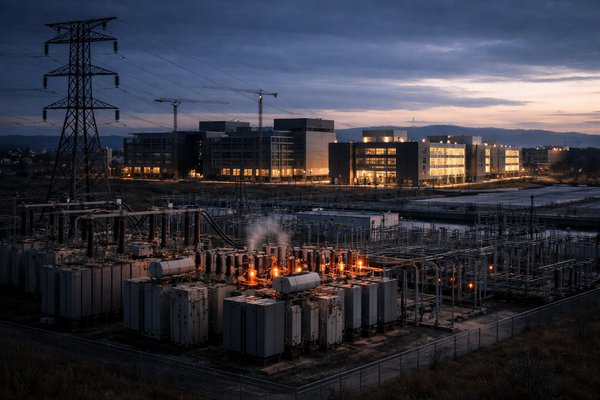
The next major bottleneck in AI is not just access to GPUs, it is access to power-ready land, grid connections, substations, switchgear, transformers, and generation capacity that can be delivered on time and at scale.
In other words, AI is no longer just a software story or even a semiconductor story. It is now an infrastructure story.
That is why so much of the most engaged commentary around AI scaling has moved in the same direction: away from abstract discussions about model size, and toward a much more practical question:
How do you actually energise these facilities fast enough to support AI growth?
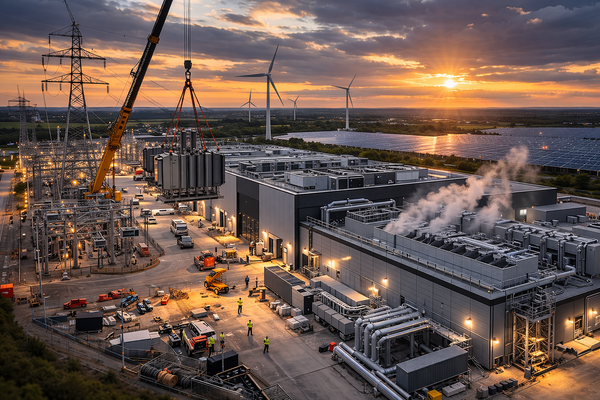
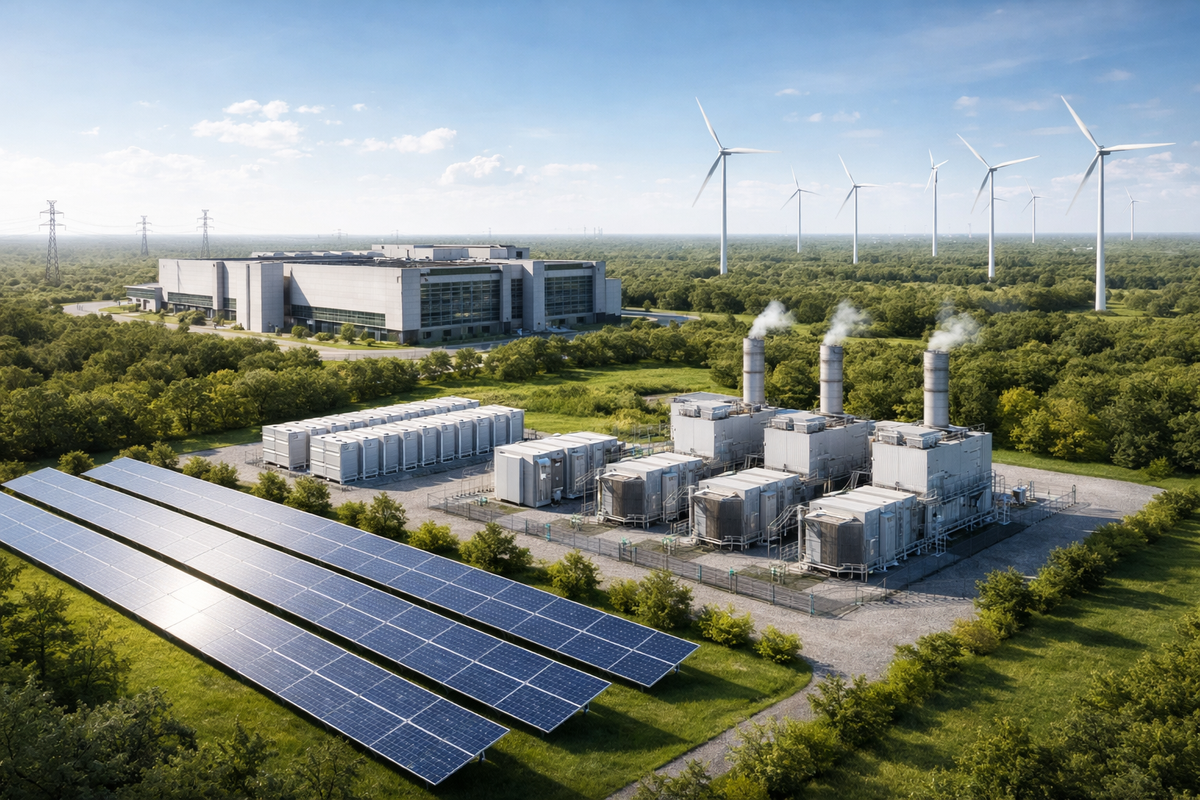
At blocz, this is not a theoretical debate, it is the delivery reality. All large-scale AI data centre construction projects we are delivering rely on on-site power generation, mainly natural gas, with renewables integrated where possible.
That is not an ideological position, it is a practical one.
Because in today’s market, the difference between a real AI project and a speculative one often comes down to a single factor: time to power!
AI has become a race for energisation
The industry still talks about scale as though the challenge is ordering more hardware. But hardware only matters once the site can support it.
A hyperscale AI facility is not just a building full of servers. It is a highly power-dense industrial asset that requires enormous volumes of electricity, resilient distribution architecture, cooling strategy, network connectivity, and a realistic path to operation. That fundamentally changes how sites are selected.
Land by itself is no longer enough, what matters now is power-capable land:
- land with a credible route to large-load energisation
- land near transmission and substations
- land where permitting, rights, and interconnection can actually move
- land where supporting infrastructure can be delivered without multi-year slippage
This is why AI infrastructure discussions are increasingly colliding with energy policy, utility planning, local politics, and industrial supply chains.
The market is waking up to a simple truth: you cannot scale AI at speed on a grid timetable that was not built for it.
The grid is necessary, but it is not always sufficient
None of this means the grid stops mattering, it matters enormously.
But large AI loads are arriving at a pace and density that many electricity systems were never designed to absorb quickly. Even where there is a long-term path to grid service, the near-term barriers are often the same: queue delays, substation upgrades, transformer lead times, transmission reinforcement, and the sheer complexity of utility coordination.
That is why the industry is increasingly moving toward hybrid strategies.
The projects getting delivered are often the ones that stop thinking in binary terms. It is not “grid or generation.” It is “what combination of grid, on-site generation, storage, and renewables gets this project operational fastest and most credibly?”
From a delivery perspective, that is the real question. And for many large AI data centres, on-site generation has become central to the answer.
Why on-site generation is moving to the centre of the conversation
On-site power generation is not attracting attention because it is fashionable. It is attracting attention because it solves a very practical problem: it gives developers and operators a route to capacity that is more controllable than waiting for every part of the grid upgrade cycle to align perfectly.
Natural gas, in particular, has become a serious part of the conversation because it offers dispatchable power, scalability, and a level of reliability that high-density AI workloads demand.
Renewables absolutely have a role to play, and they should be integrated wherever possible. They can improve the energy mix, reduce emissions intensity, and support long-term sustainability goals. But there is a difference between an energy strategy that looks good in a presentation and one that supports a live AI load with real uptime requirements.
For large-scale AI deployments, renewables on their own do not always solve the immediate energisation challenge. The operational reality is that many facilities need firm, controllable power from day one.
That is why natural gas is emerging so often in serious project delivery conversations. Not because the industry has lost interest in cleaner energy, but because the industry has run into physics, timelines, and infrastructure constraints.
The AI buildout is becoming a local issue as much as a global one
There is another reason these topics are generating such strong reaction: they touch the public directly.
When AI data centres scale aggressively, the effects are no longer invisible. Communities ask what it means for local power prices, water usage, land use, emissions, planning approvals, and grid reliability. Utilities ask how to manage unprecedented load requests. Policymakers ask who pays for the upgrades. Developers ask what can actually be built on schedule.
This is where the conversation becomes more complicated, and more interesting.
Because the future of AI will not be decided only in research labs or boardrooms. It will also be decided in planning offices, utility studies, interconnection processes, public hearings, and infrastructure procurement schedules.
That is why the most resonant content in this space is no longer just about model capabilities. It is about the friction between digital ambition and physical delivery.
People are reacting because the issue is real, immediate, and consequential.
The winners in AI infrastructure will think like builders, not just buyers
The next phase of AI growth will favour companies that understand infrastructure as a strategic capability.
Not just companies that can buy compute.
Not just companies that can announce campuses.
But companies that can align site strategy, power strategy, permitting, engineering, and delivery execution into one integrated plan.
That means asking harder questions earlier:
- Can this site actually be energised on the required timeline?
- What is the realistic mix of grid supply and on-site generation?
- Where do natural gas and renewables each make sense?
- What electrical equipment is a schedule risk?
- What does resilience look like under real operating conditions?
- How do we build local credibility, not just technical capacity?
These are no longer secondary questions, they are now critical to AI strategy.
The takeaway
The industry likes to describe AI as a race for intelligence, but increasingly, it looks more like a race for infrastructure.
The companies that move fastest will not necessarily be the ones with the boldest compute ambitions. They will be the ones that understand that scaling AI means solving for land, power, electrical infrastructure, and delivery realism at the same time.
That is the shift happening now!
The real constraint is no longer just the chip. It is the ability to turn a site into a live, resilient, power-dense AI facility on a timeline that matches demand.
At blocz, we see the shift clearly. The large-scale AI data centre projects being delivered today are not waiting for ideal conditions. They are being designed around the realities of energisation, with on-site natural gas generation and renewables where possible forming a practical path to deployment.
That may not be the simplest version of the AI story, but it is increasingly the honest one.
And in this market, honesty about what it takes to deliver is exactly what cuts through and succeeds!